Wednesday, January 13, 2010

CR-Z Beggin


Back to Main PagesWelcome to Intersections. The official online home for anything and everything having to do with the new Honda CR-Z, at least for the next nine months or so. The CR-Z sport hybrid will make its global debut in a few hours, here at NAIAS (more casually known as, the Detroit Auto Show). We’ve been teasing you with CR-Z concepts for quite some time now. But the version being revealed today is the actual North American model—what the industry calls “the production version”. It’s finally time for the real CR-Z to meet the real world.


The CR-Z’s arrival is significant simply because there’s no other vehicle out there like it. It’s a hybrid that doesn’t drive or look like a typical hybrid. We can’t wait to share more details and get more in-depth in the coming weeks and months on this site.


For now, we want to welcome you to the page and encourage you to visit often. And participate. True, this is an opportunity for us to share information with you about the CR-Z, but we also want it to be a forum for you to share your thoughts with us. The plan is to populate the site with some unique content you won’t be able to get anywhere else — guest riters, open forum discussions, games, access to the design team and more.

Look for our next post later today, from the floor of the Detroit Auto how. Complete with footage and photos of the new CR-Z sport hybrid.

From: cr-z.honda.com by Christina Ra - Manager - Honda Public Relations on January 11th, 2010 at 7:30 am

I like this stuff and maybe you could too...

Friday, August 14, 2009

Honda Civic SI (2006-present) Sixth generation (FA5/FG2)


Back to Main PagesThe Si was redesigned for the 2006 model year along with all other Civic trims, bringing about significant changes since the previous generation. The new car comes with a 2.0 liter K20Z3 i-VTEC engine that produces 197 hp (147 kW) and 139 ft·lbf (188 N·m) of torque, while also including a 6-speed manual transmission (an automatic option is unavailable) with a helical limited slip differential. Spring and dampening rates 40% stiffer than non-Si trims and stiffer sway bars have bolstered the Civic Si's handling, with the car achieving 0.90 g of lateral acceleration on the skidpad.

It is also the quickest Civic Si off the line, with a factory 0-60 time of 6.7 seconds according to Honda, but with some tests posting times as quick as 6.3 seconds. Standard features include a moonroof, a seven-speaker 350-watt sound system, 17-inch alloy wheels with 215/45R17 Michelin all-season tires, and key-less trunk access.

In Canada, the Acura CSX Type-S was offered in 2007, borrowing the engine and drivetrain from the Civic Si but offering additional luxury options including leather seating. The CSX also features the front and rear fascias like that of the JDM Civic rather than that of the USDM version.

The 2007 model changes for the Civic Si include the addition of the Si trim for sedans, vehicle stability assist (VSA) (not available on Canadian models), darker silver wheels, body-color grille, a deck lid spoiler, reversed red/black coloring on the secondary gauge cluster, and Si-embroidered front floor mats. The introductory price of the Si Coupe increased by $800 to the MSRP of $21,090.

For the 2008 model year, the Civic Si received minor tweaks that include even darker wheels than the 2007 model and a new shift boot with red stitching. Mechanical changes included a new tire pressure monitor system, a new rear upper arm that decreases the amount of rear camber, and a lowered spring rate for the coupe to match the sedan. This was also the first year the sale of the Civic Si Sedan began in Canada.


from wikipedia.org


I like this stuff and maybe you could too...

Wednesday, August 12, 2009

HONDA SOHC VTEC

Back to Main PagesHonda SOHC (Single Over Head Cam) VTEC. As popularity and marketing value of the VTEC system grew, Honda applied the system to SOHC engines, which shares a common camshaft for both intake and exhaust valves. The trade-off was that Honda's SOHC engines only benefitted from the VTEC mechanism on the intake valves. This is because VTEC requires a third center rocker arm and cam lobe (for each intake and exhaust side), and in the SOHC engine, the spark plugs are situated between the two exhaust rocker arms, leaving no room for the VTEC rocker arm. Additionally, the center lobe on the camshaft can only be utilized by either the intake or the exhaust, limiting the VTEC feature to one side.

However, beginning with the J37A4 3.7L SOHC V6 engine introduced on all 2009 Acura TL SH-AWD models, SOHC VTEC was incorporated for use with intake and exhaust valves. The intake and exhaust rocker shafts contain primary and secondary intake and exhaust rocker arms, respectively. The primary rocker arm contains the VTEC switching piston, while the secondary rocker arm contains the return spring. The term "primary" does not refer to which rocker arm forces the valve down during low-RPM engine operation. Rather, it refers to the rocker arm which contains the VTEC switching piston and receives oil from the rocker shaft.

The primary exhaust rocker arm contacts a low-profile camshaft lobe during low-RPM engine operation. Once VTEC engagement occurs, the oil pressure flowing from the exhaust rocker shaft into the primary exhaust rocker arm forces the VTEC switching piston into the secondary exhaust rocker arm, thus locking both exhaust rocker arms together. The high-profile camshaft lobe which normally contacts the secondary exhaust rocker arm alone during low-RPM engine operation is able to move both exhaust rocker arms together which are locked as a unit.

The secondary intake rocker arm contacts a low-profile camshaft lobe during low-RPM engine operation. Once VTEC engagement occurs, the oil pressure flowing from the intake rocker shaft into the primary intake rocker arm forces the VTEC switching piston into the secondary exhaust rocker arm, thus locking both intake rocker arms together. The high-profile camshaft lobe which normally contacts the primary intake rocker alone during low-RPM engine operation is able to move both intake rocker arms together which are locked as a unit.

The difficulty of incorporating VTEC for both the intake and exhaust valves in a SOHC engine has been removed on the J37A4 by a novel design of the intake rocker arm. Each exhaust valve on the J37A4 corresponds to one primary and one secondary exhaust rocker arm. Therefore, there are a total of twelve primary exhaust rocker arms and twelve secondary exhaust rocker arms.

However, each secondary intake rocker arm is shaped similar to a "Y" which allows it to contact two intake valves at once. One primary intake rocker arm corresponds to each secondary intake rocker arm. As a result of this design, there are only six primary intake rocker arms and six secondary intake rocker arms.

from wikipedia.org


I like this stuff and maybe you could too...

VTEC ENGINE Category

Back to Main PagesHonda's VTEC DOHC (Double overhead camshaft)
VTEC system is a simple method of endowing the engine with multiple camshaft profiles optimized for low and high RPM operations. Instead of one cam lobe actuating each valve, there are two: one optimized for low-RPM stability & fuel efficiency; the other designed to maximize high-RPM power output. Switching between the two cam lobes is controlled by the ECU which takes account of engine oil pressure, engine temperature, vehicle speed, engine speed and throttle position.


A Camshaft
Using these inputs, the ECU is programmed to switch from the low lift to the high lift cam lobes when the conditions mean that engine output will be improved. At the switch point a solenoid is actuated which allows oil pressure from a spool valve to operate a locking pin which binds the high RPM cam follower to the low rpm ones.

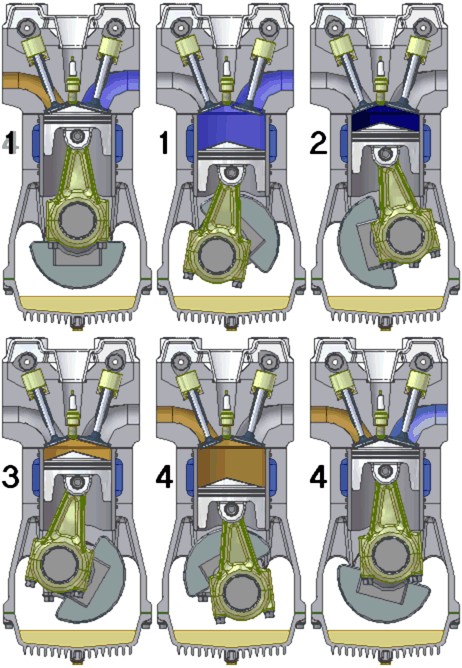
Double overhead cams control the opening and closing of a cylinder's valves.
1. Intake
2. Compression
3. Ignition
4. Exhaust
From this point on, the poppet valve opens and closes according to the high-lift profile, which opens the valve further and for a longer time. The switch-over point is variable, between a minimum and maximum point, and is determined by engine load. The switch back from high to low rpm cams is set to occur at a lower engine speed than the up-switch to avoid a situation in which the engine is asked to operate continuously at or around the switch-over point.

- Introduced as a DOHC System in the 1989 Honda Integra and Civic CRX SiR models sold in Japan and Europe, which used a 160 bhp (119 kW; 162 PS) variant of the B16A engine.

- The US market saw the first VTEC system with the introduction of the 1991 Acura NSX, which used a DOHC VTEC V6 with 270 hp (200 kW).

- DOHC VTEC engines soon appeared in other vehicles, such as the 1992 Acura Integra GS-R (B17A 1.7 liter engine).

- And later in the 1993 Honda Prelude VTEC (H22 2.2 liter engine with 195hp) and Honda Del Sol VTEC (B16 1.6 liter engine).

- Honda has also continued to develop other varieties and today offers several varieties of VTEC, such as i-VTEC and i-VTEC Hybrid


DOHC (Double overhead camshaft) valve train layout is characterized by two camshafts located within the cylinder head, one operating the inlet valves and one operating the exhaust valves. Some engines have more than one bank of cylinder heads (V8 and flat-four being two well-known examples) and these have more than two camshafts in total, but they remain DOHC. The term "twin cam" is imprecise, but will normally refer to a DOHC engine. Although most more than 2-valve per cylinder heads employ DOHC, some manufacturers still managed to use a SOHC in 4-valve layouts. Honda for instance with the later half of the D16 family, this is usually done to reduce overall costs. Also not all DOHC engines are multivalve engines-DOHC was common in two valve per cylinder heads for decades before multivalve heads appeared. Today, however, DOHC is synonymous with multi-valve heads since almost all DOHC engines have between three and five valves per cylinder


I like this stuff and maybe you could too...

The Story of Greet VTEC ENGINE

Back to Main Pages
What is VTEC
The Legenery VTEC (Variable Valve Timing and Lift Electronic Control) is a valvetrain system developed by Honda to improve the volumetric efficiency of a four-stroke internal combustion engine. This system uses two camshaft profiles and electronically selects between the profiles. It was invented by Honda R&D engineer Ikuo Kajitani. It can be said that VTEC, the original Honda variable valve control system, originated from REV (Revolution-modulated valve control) introduced on the CBR400 in 1983 known as HYPER VTEC.

Honda's VTec is a enginering system originally designed for their engines to keep their great fuel economy, while giving extra power at higher rpm's. when the vtech is activated, oil pressure within the head increases to add a larger stroke to lobes on the cams, therefore letting more air in and out of the engine. Here the story of greet VTec Engine.
 
VTEC was the first system of its kind, though other variable valve timing and lift control systems have been produced by other manufacturers (MIVEC from Mitsubishi, VVTL-i from Toyota, VarioCam Plus from Porsche, VVL from Nissan, etc).


I like this stuff and maybe you could too...

Monday, July 20, 2009

HONDA CIVIC SI HATCHBACK - 5th Generation (EP3) 2002-2005


 This is very nice Civic, but the gear at dashboard make this civic funy. In 2002, the Civic Si received a complete redesign and returned to form as a hatchback. The body shape of this model was based on the "New Bullet-Form" concept, which aimed to create a more dynamic look and provide greater stability while traveling on highways or winding country roads.

The interior layout also distinguished itself from other Civic Si generations with a dash-mounted shifter. Based on a platform manufactured at the Swindon plant in England, the hatchback was launched around the world in many different trims, most notably as the Civic Type R in Europe and Japan. Shifting away from the B-series engine, the seventh generation Civic Si adopted the K-series K20A3 engine, which put down 160 hp (119 kW) at 6,500 RPM and 132 lb·ft (179 N·m) of torque at 5,000 rpm.[12] With a redline of 6,800 RPM, the Si distanced itself from the narrow, high-RPM powerband engine of its predecessor, and as a result saw a 20 percent increase in torque.

Performance was relatively underwhelming compared to the competition; the switch to MacPherson struts from double-wishbone suspension resulted in less responsive handling, and a near-150 lb increase in weight to 2,744 lb contributed to slower acceleration than the lighter '99-'00 Si. Much of the weight gain is attributed to the chassis' stouter structure when compared to the previous generation hatchback, with the '02 Si boasting an increase in torsional rigidity by 95 percent and a bending rigidity increase of 22 percent. With the increased chassis rigidity compensating for weight gain, the 5th-generation Civic Si saw roughly the same performance numbers as the previous generation Si, with 7.6 seconds to 60 mph and 15.8 seconds at the quarter mile.
Other factors adversely impacting performance included the lack of an LSD (limited slip differential) and having to shift into third gear to get to 60. First gear ends at about 30, second ends at 55, and third ends at 82 mph (132 km/h). The '04-'05 models received minor revisions. Cosmetic changes included revised headlight (dual bulb setup) and taillight designs, standard side skirts, and an option for a HFP.
The suspension was updated with a change from 4 lug to 5 lug bolt pattern, a larger rear sway bar, and a change from the 15-inch wheels (195/60-15) to the 16-inch wheels (205/55-16).
The interior received more silver accents in place of the chrome ones (the lock switch).
The Honda chassis code for the Si and Type-R models is EP3. In Canada it is referred to as the Honda Civic SiR, and was discontinued in 2005. There was no high performance Si derived from the seventh generation USDM Civic sedan or coupe.
from wikipedia.org

I like this stuff and maybe you could too...

Honda JDM Civic Type-R - (EK9 Vtec) 1st Generation 1997-2000


Production years : 1997-2000
Body Style (s) : 3-door hatchback
Transmission (s) : 5-speed manual (With LSD)
Engine (s) : 1.6 L B16B Vtec I4
Note: This engine uses the same block as the Integra Type R, which is taller than the B16a block, but with a crank the same stroke as the b16a. It uses longer rods to accommodate for this, which is why the Rod/Stroke ratio is higher than a standard B16. It is basically a 'Destroked B18C Type R

The EK9 Civic Type R was preceded by two previous generations of unofficial Type R's - the EF9 SiR I and EG6 SiR II. The EF9 was the first Civic to feature the 'Racing' moniker, in the form of the top of the line SiR trim, featuring racing technology available in a production car.

The first Civic to officially receive the Type R badge was introduced in 1997 as the EK9. As a hatchback which continued the 'R' philosophy from the 2 previous SiRs, the EK9 shared many characteristics with the Integra Type R DC2 such as omission of sound deadening and other weight-reduction measures, a hand-ported B16B engine, front helical limited-slip differential and close ratio gearbox etc.

The B16B engine boasted one of the highest power output per litre of all time for an NA engine with 185 PS (136 kW; 182 hp) from a 1.6L. For the first time, a strategically seam welded monocoque chassis was used to improve chassis rigidity. The interior featured red Recaro seats, a titanium shift knob and a Momo steering wheel. In 1999 the Type Rx was introduced featuring a CD player, body colored retractable electric door mirrors, power windows, auto air conditioning, keyless entry unlock system, aluminum sports pedals, and a carbon type center panel.

The SiR badge from the previous 2 generations was ceded to the EK4 Civic as a mainstream sedan and hatchback which was sold in huge numbers across the globe due to its relatively low cost, practicality and everyday usable street performance/driveability.